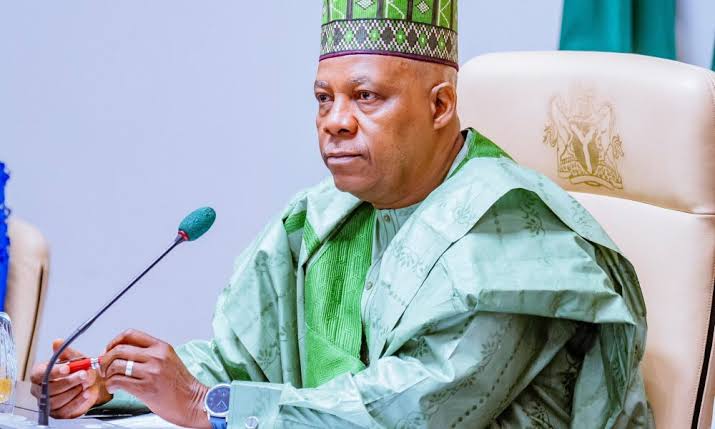

The African Democratic Congress Presidential Campaign Council (ADC PCC) has criticised Vice-President Kashim Shettima over his assertion that President Bola Tinubu rescued Nigeria from the brink of economic collapse, arguing that the claim raises questions about the record of the All Progressives Congress (APC) administration under former President Muhammadu Buhari.
In a statement issued on Sunday, October 4, the council’s Director of Media and Publicity, Kola Ologbondiyan, said the APC could not distance itself from the country’s economic conditions before Tinubu assumed office in May 2023.
The ADC campaign council argued that if Nigeria’s economy was approaching collapse at the time, as Shettima claimed, the previous APC-led government should also accept responsibility for the circumstances that preceded Tinubu’s presidency.
The criticism followed remarks by Shettima on Saturday in which he defended Tinubu’s economic decisions, particularly the removal of the petrol subsidy and the unification of multiple exchange rates.
ADC questions APC’s eight-year record
Ologbondiyan recalled that Tinubu had previously said his administration would build on the legacy of Buhari’s government.
The ADC campaign council argued that the president and vice-president could not simultaneously invoke the previous administration’s legacy while attributing the economic difficulties inherited in 2023 solely to conditions predating the APC’s time in office.
The statement forms part of the opposition’s wider criticism of the Tinubu administration’s economic record ahead of the 2027 general election.
The ADC’s position is a political argument about responsibility for Nigeria’s economic trajectory. It does not, by itself, establish the relative contribution of each administration to the country’s economic challenges.
Tinubu’s reforms remain contested
Since taking office in May 2023, Tinubu has implemented major economic policy changes, including ending the petrol subsidy and unifying the country’s foreign-exchange windows.
The government has defended the measures as necessary to address fiscal pressures and improve the functioning of the economy. Critics, however, have focused on their effects on petrol prices, transportation costs, inflation and household purchasing power.
Evaluating the reforms requires consideration of multiple indicators, including inflation, real incomes, economic growth, public debt, foreign-exchange conditions and government revenue, as well as the costs and benefits experienced by different groups.
Economic policy enters the political debate
The exchange between Shettima and the ADC campaign council underscores how economic management is likely to feature prominently in the run-up to the 2027 election.
The central disagreement concerns not only whether the reforms were necessary, but also how responsibility should be allocated for the conditions inherited by the current administration and the hardship experienced during the transition.
Further evidence from official economic data and policy outcomes will be needed to assess the competing political claims.