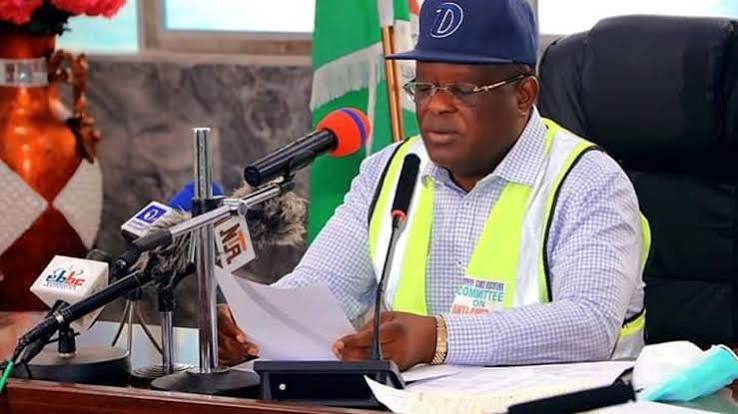

The Federal Government is providing 30 per cent of the funding for the Lagos-Calabar Coastal Highway, while external financing institutions are expected to provide the remaining 70 per cent, Minister of Works David Umahi has said.
Umahi explained that the financing arrangement operates under an Engineering, Procurement, Construction and Financing (EPC+F) model, under which project delivery and financing are coordinated with external lenders.
“The entire Tinubu legacy projects are EPC+F — Engineering, Procurement, Construction and Financing. Thirty per cent is paid by the Federal Government and 70 per cent is financing loan from external financing institution,” the minister said.
He added that Deutsche Bank arranged financing for the first section of the coastal highway and that the facility was oversubscribed by $100 million, indicating that lender commitments exceeded the amount initially sought. The oversubscription figure was part of Umahi’s disclosure and should be distinguished from the total value of the loan facility.
How the financing arrangement works
Under the EPC+F model described by Umahi, the Federal Government contributes part of the project cost, while external financing institutions are expected to provide the balance through loans or other agreed financing arrangements.
The minister said lenders conduct due diligence before committing funds. Such reviews can involve assessing the project’s financial structure, implementation arrangements, repayment obligations and associated risks.
The financing model is intended to enable the government to pursue major infrastructure projects without relying exclusively on immediate budgetary allocations.
However, borrowing still creates repayment obligations, making the loan terms, interest costs, repayment schedule and allocation of financial risks important considerations in assessing the model’s long-term implications.
Deutsche Bank-led financing for the first section
The Federal Ministry of Finance announced in July 2025 that Deutsche Bank had led a $747 million syndicated loan for Phase 1, Section 1 of the Lagos-Calabar Coastal Highway, covering a 47.47-kilometre stretch from Victoria Island towards Eleko Village.
The financing syndicate included First Abu Dhabi Bank, the African Export-Import Bank, the Abu Dhabi Exports Office, the ECOWAS Bank for Investment and Development, and Zenith Bank. The Islamic Corporation for the Insurance of Investment and Export Credit provided partial political and commercial risk insurance.
The disclosed facility provides a concrete example of external financing being used for an initial section of the wider highway project.
The $747 million facility relates to that specific section; it should not be confused with the total cost of the entire Lagos-Calabar Coastal Highway.
Project scale and accountability
The Lagos-Calabar Coastal Highway is a major federal infrastructure project intended to link Nigeria’s commercial centre with communities along the country’s southern coastline.
Its wider economic case rests on the potential to improve connectivity, facilitate trade, reduce travel bottlenecks and support development along the corridor. Realising those benefits will depend on construction quality, delivery timelines, access arrangements and the cost of maintaining the completed road.
The project’s financing also raises questions about public accountability. Clear disclosure of loan terms, government contributions, project milestones and repayment commitments would help Nigerians assess the financial implications of the arrangement.
What to watch next
The key measures of progress will include the release and use of financing, construction milestones, adherence to agreed costs and timelines, and the transparency of contractual obligations.
Umahi’s disclosure clarifies the government’s stated financing approach, but the overall fiscal impact can only be assessed fully through the detailed terms of the financing agreements and the project’s final cost.