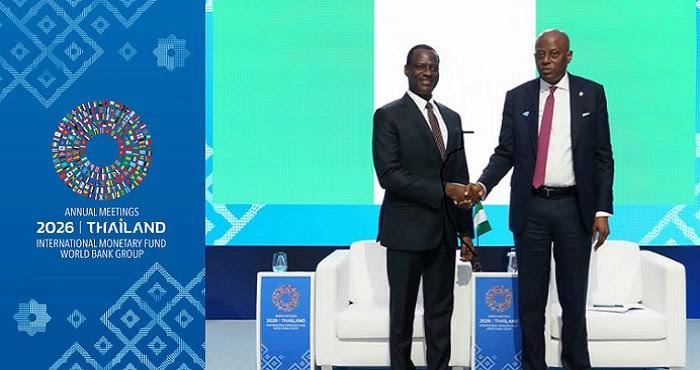
Nigeria has presented an investment pipeline valued at $78.5 billion as the Federal Government seeks to attract domestic and international capital, accelerate economic growth and expand employment opportunities.
The initiative was showcased during Nigeria’s participation in the 2026 Annual Meetings of the International Monetary Fund and World Bank Group in Bangkok, Thailand.
Finance Minister and Coordinating Minister of the Economy Taiwo Oyedele and Central Bank of Nigeria Governor Olayemi Cardoso presented the government’s economic reform narrative and investment opportunities to prospective investors.
According to the Federal Ministry of Finance, the investment pipeline comprises 65 projects across five broad sectors, with a combined capital requirement of approximately $78.5 billion.
The government is seeking to convert improved macroeconomic stability into stronger private-sector investment, increased productivity and employment.
Investment Opportunities Across Five Sectors
The proposed projects cover oil, gas and power; transport and maritime infrastructure; manufacturing and mining; agriculture and agro-processing; and technology, healthcare and urban services.
The pipeline is intended to give investors a structured view of projects requiring capital and to connect project sponsors with potential financing partners.
The ministry’s published materials estimate that the portfolio could support hundreds of thousands of jobs if the projects are developed and implemented as planned.
However, the $78.5 billion figure represents the capital requirement of proposed investment opportunities. It should not be interpreted as funding already secured or as money already invested in Nigeria.
Government Highlights Economic Indicators
At the meetings, Nigerian officials also highlighted indicators they said reflected progress from recent reforms.
These included economic growth of about 4.4 per cent in the second quarter of 2026, four consecutive months of declining inflation, foreign reserves above $55 billion, a tax-to-GDP ratio of 12.5 per cent and public debt equivalent to approximately 36 per cent of GDP.
The figures were presented as evidence of improving economic conditions and a foundation for further investment.
However, the impact of economic reforms will also be judged by their effects on household purchasing power, employment, production costs and living standards.
Turning Investment Plans Into Jobs
Nigeria’s challenge is to turn proposed projects into operational businesses and infrastructure that generate measurable economic benefits.
That will require credible project preparation, transparent procurement, predictable regulation, access to financing and sustained investor confidence.
The scale of the pipeline signals the government’s ambition to attract capital across strategic sectors. Its ultimate significance, however, will depend on how many projects reach financial close, begin construction and deliver the promised jobs and economic activity.