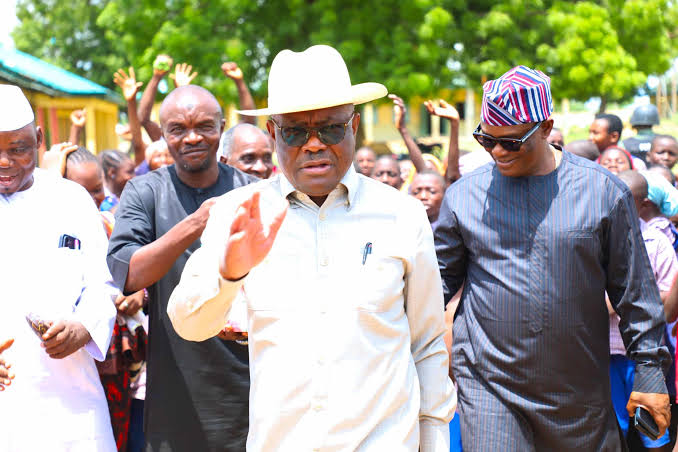
Minister of the Federal Capital Territory, Nyesom Wike, has weighed in on the Osun State governorship election, suggesting that President Bola Tinubu could have secured an APC victory if he had chosen to deploy the full weight of his political influence.
Wike’s comment is significant because it frames the Osun contest not merely as a state-level election but as a test of how much influence the presidency and the ruling party can realistically exert over an electorate.
The FCT minister has remained one of Tinubu’s prominent political allies despite retaining his membership of the Peoples Democratic Party.
His relationship with the President has repeatedly attracted attention as Nigeria moves toward the 2027 election cycle.
Earlier in 2026, political commentators had already identified Wike as a key figure in efforts surrounding Tinubu’s re-election campaign and the weakening of the opposition. One analysis in The Guardian described the emerging relationship between Wike and Tinubu as central to the administration’s broader political calculations ahead of 2027.
Against that background, Wike’s assessment of Osun becomes politically important.
The argument suggests that Tinubu’s influence is substantial but not necessarily unlimited.
The President’s APC had entered the Osun contest with a strong political structure and fielded Bola Oyebamiji against incumbent Governor Ademola Adeleke, who contested under Accord. INEC’s candidate list confirmed the two as major contenders in the race.
Yet the election remained fiercely contested.
Adeleke’s campaign had openly challenged the idea that APC’s political heavyweights could determine the outcome, insisting that voters would make the final decision.
Wike’s argument essentially turns that campaign claim into a broader political question: how far can political power go before it encounters the independent choices of voters?
His comments also fit into a wider debate about Tinubu’s 2027 prospects.
The President is expected to seek another term, and political realignments across the country have already intensified.
Wike has been particularly outspoken about the prospects of Tinubu’s re-election, while simultaneously positioning himself as an influential figure in the political negotiations surrounding the next presidential contest.
The Osun election therefore offers another lens through which to examine the relationship between incumbency, party machinery and voter choice.
Even if the presidency possesses considerable political influence, deploying that influence aggressively in a state election could carry its own risks.
It could strengthen the ruling party’s chances, but it could also deepen perceptions that federal power is being used to determine state-level political outcomes.
That tension is likely to remain relevant as Nigeria approaches 2027.
For Wike, however, the message appears straightforward: Tinubu had the political capacity to influence the Osun contest much more aggressively, but chose not to pursue victory “at all cost.”