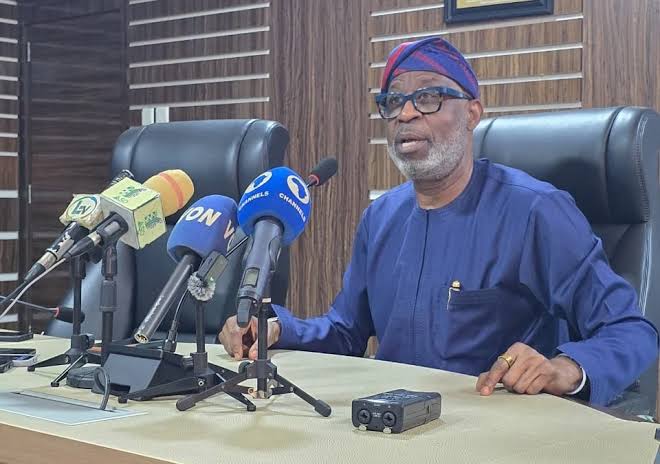
Minister of Solid Minerals Development, Dele Alake, has defended President Bola Ahmed Tinubu’s decision to remove Nigeria’s petrol subsidy, arguing that the President accepted significant political risks in pursuit of what he described as long-term economic reforms.
Alake made the remarks during an interactive session with journalists in Abuja, shortly after his appointment as Director of Strategic Communications for the All Progressives Congress (APC) 2027 Presidential Campaign Council.
According to the minister, previous administrations had recognised the need to reform the subsidy system but repeatedly delayed decisive action because of concerns about public protests, elections and the political consequences of unpopular economic policies.
He said Tinubu chose a different path by implementing the reform despite knowing that it would generate hardship and political backlash.
‘He Took the Bullets’
Alake said the President effectively took the political “bullets” associated with the subsidy removal on behalf of the country.
He argued that the decision required political courage because Tinubu, as an elected politician seeking another term, was aware that the policy could affect his popularity.
“Somebody came and decided to swallow the bitter pill, to take the bullets on behalf of Nigerians,” Alake said.
The minister maintained that the country needed to confront economic distortions rather than continue postponing difficult decisions for electoral convenience.
He said successive governments had understood the problems associated with the subsidy regime but lacked the political will to fully address them.
Subsidy Benefited Cartels, Alake Claims
Alake also argued that the former subsidy arrangement did not necessarily deliver its greatest benefits to ordinary Nigerians.
He alleged that fuel cartels and other powerful interests benefited substantially from the system, including through the smuggling of subsidised petroleum products across Nigeria’s borders.
According to him, the government lost resources that could have been deployed to infrastructure and other productive sectors.
Alake further recalled that several states previously struggled to meet salary obligations despite the existence of fuel subsidies.
He argued that maintaining an unsustainable system simply because of its political implications would only postpone the underlying economic problems.
Reform Comes With Pain
The minister acknowledged that the removal of the subsidy had imposed significant pressure on Nigerians but maintained that major economic reforms rarely produce immediate benefits without an adjustment period.
He said the government needed to remain consistent with its reforms rather than reverse them because of political pressure.
Tinubu announced the end of the petrol subsidy during his inauguration on May 29, 2023. The decision triggered a sharp increase in petrol prices and contributed to higher transportation and living costs, while the Federal Government has maintained that subsidy removal was necessary to improve public finances and redirect resources.
The subsidy debate has since become a major political issue ahead of the 2027 presidential election, with opposition figures offering different proposals on how petrol prices and the wider energy sector should be managed.
Alake, however, maintained that Tinubu deserved recognition for taking what he described as a politically difficult decision.