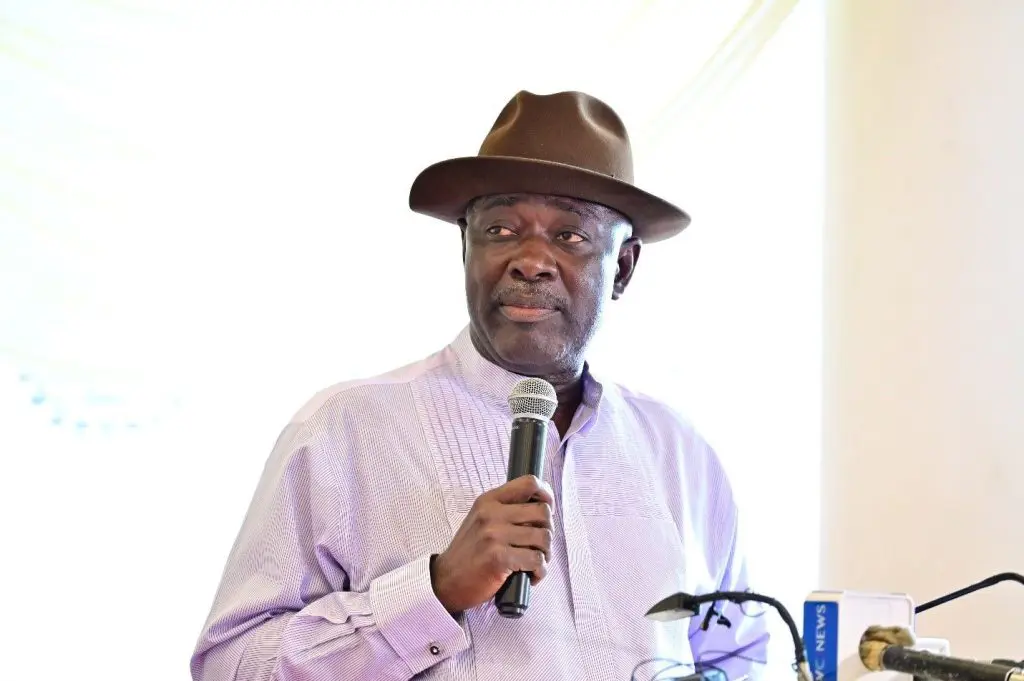
The Minister of State for Petroleum Resources (Oil), Senator Heineken Lokpobiri, has defended the Federal Government’s decision to remove the petrol subsidy, arguing that the policy prevented Nigeria from following what he described as Venezuela’s economic trajectory.
Lokpobiri made the remarks while speaking on the government’s petroleum-sector reforms, with reports of his comments coming as the administration continues to defend the economic rationale behind subsidy removal.
According to the minister, the former subsidy regime placed a substantial burden on public finances without delivering commensurate benefits to the wider population.
“Subsidy removal was the reason why Nigeria didn’t go the way of Venezuela; otherwise, Nigeria would have collapsed,” Lokpobiri was quoted as saying.
He also argued that the subsidy system had disproportionately benefited a limited group rather than Nigerians generally.
The minister’s comments form part of the Federal Government’s broader defence of the reforms introduced since President Bola Tinubu assumed office, particularly the removal of the petrol subsidy in 2023.
Government points to savings from subsidy removal
The Federal Government has repeatedly argued that ending the subsidy created additional resources for the federation and reduced pressure on public finances.
Finance Minister and Coordinating Minister of the Economy, Taiwo Oyedele, said in August that the removal of the petrol subsidy had generated N15.8 trillion in savings for the Federation between June 2023 and December 2025.
Oyedele said the savings represented resources mobilised for the Federation, although they did not appear as a separate credit to the Federation Account under the description “subsidy savings.”
The government has consequently linked subsidy removal to increased fiscal capacity and the redirection of resources toward other priorities.
However, the policy has remained one of the most contentious economic decisions of the Tinubu administration.
The removal of the subsidy immediately altered the economics of petrol consumption and contributed to a sharp increase in transport and living costs, while the subsequent naira depreciation and other economic pressures further affected household purchasing power.
The government’s argument has therefore centred on long-term fiscal sustainability and the need to end what it regarded as an expensive and inefficient subsidy system, while critics have focused on the immediate burden placed on households and businesses.
Venezuela comparison
Lokpobiri’s reference to Venezuela invokes a country whose economy experienced prolonged fiscal, monetary and structural crises alongside a heavy dependence on oil revenues.
The minister did not suggest that Nigeria and Venezuela were identical economies but used the comparison to underscore his argument that maintaining the previous subsidy system could have deepened Nigeria’s fiscal problems.
His position is part of the administration’s continuing effort to explain and defend the reforms, rather than an independently established finding that subsidy removal alone prevented a Venezuela-style crisis.
The economic debate over the policy is likely to remain prominent ahead of the 2027 elections as Nigerians assess the effects of the reforms on government finances, fuel prices, inflation, employment and household welfare.